The Rise of Bio-Digital Passports: Integrating Blockchain Security into Next-Gen Wearable Tech
- qmshahzad
- Mar 2
- 4 min read
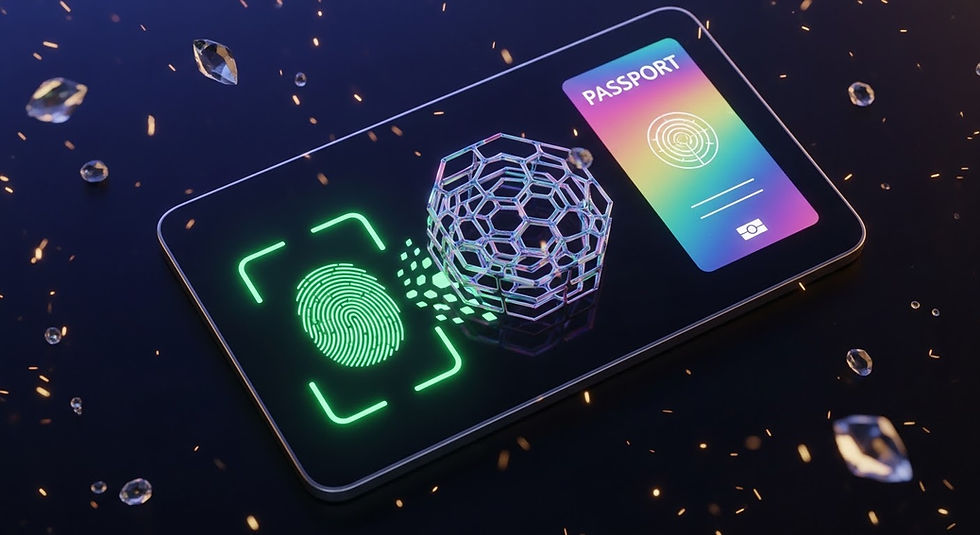
It is March 2026, and the concept of identity is undergoing its most radical transformation in history.
For centuries, identity has been external. Passports. Plastic cards. PIN codes. Passwords. Centralized databases. Every system built on the assumption that identity is something you carry.
Now, that assumption is breaking.
The next evolution of authentication is not something you hold. It is something you are.
Welcome to the era of bio-digital passports.
The Collapse of Traditional Identity Systems
Physical IDs are fragile. They can be lost, forged, or stolen. Centralized databases are vulnerable to breaches. Password-based systems fail because humans are predictable.
Even multi-factor authentication still relies on external devices that can be hacked or duplicated.
In recent years, digital identity initiatives such as Worldcoin and decentralized ecosystems built on Ethereum have attempted to redefine identity verification through blockchain technology.
But these systems still depend on external hardware: phones, wallets, authentication apps.
The real breakthrough comes when identity moves from external devices into the biological layer itself.
What Is a Bio-Digital Passport?
A bio-digital passport is a cryptographic identity generated from live physiological data and anchored to a decentralized ledger.
Instead of storing identity as a document or password, the system derives a unique cryptographic signature from:
Heartbeat rhythm patterns
Dermal electrical signals
Blood oxygen variability
Micro-fluctuations in pulse
These biometric signals are continuously converted into encrypted hashes. The hashes — not the raw medical data — are recorded on a decentralized blockchain network.
The result is a living identity key.
Authentication only works if the biological signal is present and matches the blockchain-anchored proof.
No pulse. No access.
The Role of Blockchain in Biological Identity
Blockchain provides three critical properties for bio-digital passports:
Immutability
Decentralization
Verifiable transparency
On scalable networks similar to Polygon, identity proofs can be stored in a distributed system rather than a central server.
This eliminates single points of failure.
If a centralized database is hacked, millions of identities are compromised.If a decentralized ledger is attacked, consensus mechanisms protect the integrity of stored cryptographic proofs.
More importantly, blockchain enables zero-knowledge verification.
Using zero-knowledge proofs, systems can confirm that:
"This biological signature matches the registered identity"
Without exposing the underlying medical or biometric data.
This is where privacy engineering becomes as important as cryptography itself.
Hardware That Becomes Skin
Wearable technology has evolved rapidly over the past decade. Devices like the Apple Watch introduced mass-market biometric tracking.
But bio-digital passports require something more seamless.
The next generation of wearable technology includes:
Ultra-thin epidermal electronic patches
Flexible bio-integrated sensors
Sub-dermal micro-devices powered by body heat or kinetic energy
These devices continuously collect physiological signals and synchronize encrypted identity proofs with decentralized verification nodes.
Unlike removable devices, epidermal electronics reduce volatility. They are persistent, difficult to duplicate, and biologically bound to the user.
The hardware becomes an extension of the body.
But with that evolution comes a deeper question: Who controls the firmware that defines your identity?
The Security Model: Proof of Life
Traditional authentication checks what you know (passwords) or what you have (tokens).
Bio-digital passports introduce a third layer: proof of life.
Authentication requires:
A live biological signal
Real-time biometric verification
Blockchain-matched cryptographic hashes
Transactions, border crossings, banking operations, and secure facility access can all require a verified pulse before authorization.
This eliminates identity theft in its traditional form.
A stolen password can be reused.A copied card can be cloned.But a live biological signature cannot be replicated without the living source.
In theory, this creates the most secure authentication model ever designed.
In practice, implementation determines everything.
The Ethical and Societal Shift
The integration of biological identity with blockchain is not purely technical.
It is societal.
As airports, financial institutions, and governments explore digital identity frameworks — discussions echoed in global policy conversations within institutions such as the World Economic Forum — bio-digital verification could become a new standard.
Imagine:
Seamless airport passage without physical passports
Banking systems that verify identity instantly
Secure facilities that authorize entry through bio-recognition
But ethical concerns are unavoidable:
Who owns the biological hash?
Can an identity be revoked?
Can participation remain voluntary?
What safeguards prevent state-level misuse?
The merging of biology and blockchain forces humanity to redefine sovereignty.
If identity becomes permanently anchored to a decentralized ledger, control over one’s digital self becomes inseparable from physical existence.
The Future of Personal Sovereignty
Bio-digital passports represent more than a technological upgrade.
They represent a shift in how humans relate to identity, privacy, and security.
The promise is compelling:
Elimination of identity theft
Reduced fraud
Seamless global verification
Stronger cryptographic trust
But the risk is equally significant:
Surveillance expansion
Irreversible digital footprints
Hardware dependency
Biometric commodification
Technology does not determine the future. Governance and design choices do.
The line between biology and technology is fading. The question is no longer whether integration will happen.
The real question is whether humanity will build systems that enhance freedom — or systems that quietly centralize power under the illusion of decentralization.
Bio-digital passports could be the most secure identity system ever created.
Or they could redefine control in ways we are not yet prepared to confront.
The next phase of identity will not be written in plastic.
It will be written in code — and in biology.
Comments